Single-Leg Jump Symmetry & Injury Prevention
- Drew Pomeroy
- Jun 28, 2022
- 4 min read


In my last post, I impressed upon the importance of consistency in monitoring jump metrics alongside batted ball exit velocity to see how power outputs change during an 8-week strength program.
Summarized: the athletes on average gained muscle (+13 lbs), improved strength (+57 lbs back squat, +56 lbs deadlift, +37 lbs hang clean), increased power (+2.20 in jump height, -0.03 sec GCT, +0.30 RSI), and improved batted ball exit velocity (+7 mph).
Not only did we capture these power metrics, but we also met with the athletes during the program to discuss their lower-half symmetry.
WHAT IS SYMMETRY?
To understand symmetry, we need to understand the assessment itself, alongside the metrics collected.
Just as we asked the athletes to complete a Continuous CMJ (3 jumps), we also asked our athletes to complete a Single Leg Continuous CMJ (x3 jumps) on each leg. The goal of these jumps is to lower Ground Contact Time, increase jump height, and stay under control over the course of the three jumps. To the athlete, we say: "jump as high as you can, as quick as you can" to impress the importance of generating jump height quickly.
The metrics of interest are as follows:
Ground Contact Time (sec)
Jump height (in)
Jump Power (Power Quotient)
Reactive Strength Index (RSI)
What are we looking for? While the performance of each leg is important, we also looked at how one leg performs in relation to the other. This lower-half symmetry can aid in keeping athletes healthy and performing at their highest potential. For the average competitive teenage athlete (ages 13-18), lower-half RSI generally falls around 10-12%, and lower-half power & height comes in around 4-6%.
By tracking the performance of one leg in relation to the other, we are able to see if an athlete starts to get a little too out of wack. What we have found as a general rule of thumb is that when an athlete is approaching 20% RSI symmetry, or 15% Power symmetry, it is time to have a conversation and dive into what the reason might be. That reason could be a number of things: overuse (training too much too often), significant outside stressors, former injury rearing its ugly head, fatigue, improper nutrition, or not telling anyone that you're working out 3x as much as you should be (okay that last one is a sore spot...but happens far more often than you think).
POTENTIAL INJURY PREVENTION
The athletes in this program made incredible improvements, but by monitoring single-leg jump performance & symmetry, we were also able to catch potential injuries before they became a real problem.
Over the course of 8 weeks, we identified two athletes with a potential for injury and were able to intervene accordingly. In this section, we will highlight 1) the best-case scenario athlete, 2) the potential injury scenario athlete, and how we were able to mitigate pain and discomfort for that athlete.
Below is a graph for one of the most symmetrical athletes during the 8 weeks who showed no concern for injury.
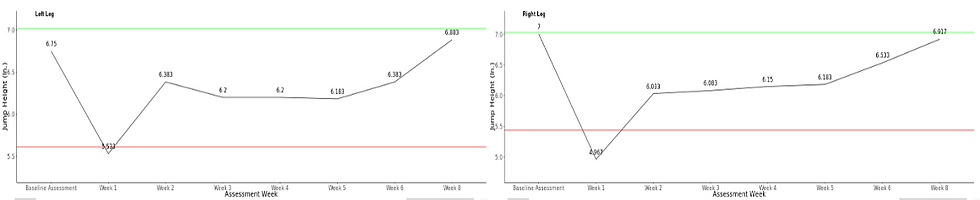
This athlete's left leg vs. right leg jump height is nearly identical each week of the program. This athlete's symmetry never went larger than 6% during the program and the athlete never reported any signs of pain or discomfort. This athlete also made some of the best performance improvements during the program (+2.20 in jump height, +0.52 RSI, and +15.6 mph exit velocity!).
Now that we objectively know what "good" looks like, let's identify what to look for to determine the potential for injury. The graph below shows an athlete that required modified participation in the program to ensure he could stay healthy and available for his upcoming season.
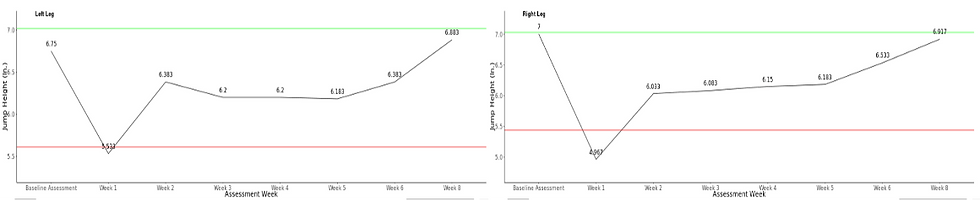
This single-leg jump graph is all over the place. This athlete's jump height symmetry was at 5% in week 1 of the program, and by week 4 he had a 22% asymmetry - which only got worse (the athlete asked to continue with weekly jump evaluations & hitting, but was modified in the gym to avoid injury). On top of this, the athlete reported to us in athlete meetings that he was not only participating in a challenging 8-week strength program but also participating in a speed program, lifting class at high school, team workouts, and had weekend tournaments. Remember when I mentioned athletes not telling you how much they're truly working out... yeah, that's the sore spot. This was a classic case of overuse surfacing around weeks 3-4.
To do our part in mitigating injury risk, we modified his participation in the strength program to manage some of his workloads. He was still able to reap some rewards from the program without suffering any further time-loss injuries. Even though we could not push his jump performance or gym routine too far, he was still able to add +4 mph in batted ball exit velocity.
MAIN TAKEAWAY
Tracking an athlete's symmetry over the course of an off-season strength program allowed us to make better decisions to keep the athletes healthy and available. There were two big events that happened that allowed us to uncover what the root cause of this potential for injury was.
Monitoring Jump Performance - By objectively tracking this athlete's jump symmetry over just a few weeks showed us that something was affecting this athlete in a negative way.
Athlete Meetings - By introducing athlete meetings with a few members of the performance staff, we were able to uncover that the athlete was experiencing some pain and discomfort that was stemming from activities outside of the current strength program.
Having that dialogue with this athlete could have saved this athlete from a severe injury. Athletes tend to 'play through the pain' to show that they are tough, but being able to show the athlete a negative trend in their performance (jump symmetry) along with creating an open and honest environment (in the gym & in athlete meetings) allowed us to get to the root cause of the discomfort the athlete was feeling - ultimately modifying their participation to prevent that potential injury from worsening.
Flash Forward: this athlete is now in the top 3 producers on his high school team in Runs, Slugging, Triples, and Doubles. By having the right mentality & focus on staying healthy, he was able to do what was needed to get on the field and produce for his team.


Comments